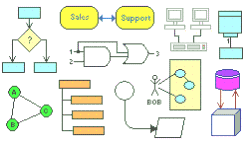
There is no limit to the variety of uses for block-and-flow
diagrams. Most arise spontaneously for ad-hoc purposes and
adopt meaning to suit the specific environment and circumstances.
However, many diagramming methodologies and standards have
also arisen based on the basic block and flow. They include
flowcharts, org charts, data flow diagrams, state diagrams,
Entity-Relation (ER) diagrams, and Unified Modeling Language (UML).